 businessscales
Businesses in 2026 are no longer experimenting with artificial intelligence — they are building growth strategies around it. The AI Agent Landscape now includes digital agents that use advanced intelligence to conduct conversations and assess leads and provide customer assistance and create business income.
AI agents do not need human workers because they can handle their tasks through self-directed learning and operational independence which distinguishes them from conventional software. The new business methods establish fresh methods for organizations to handle their sales processes and customer support systems and operational activities across extensive networks.
Let us examine the ways in which the AI Agent Landscape brings about change in contemporary business operations.
What Is the AI Agent Landscape?
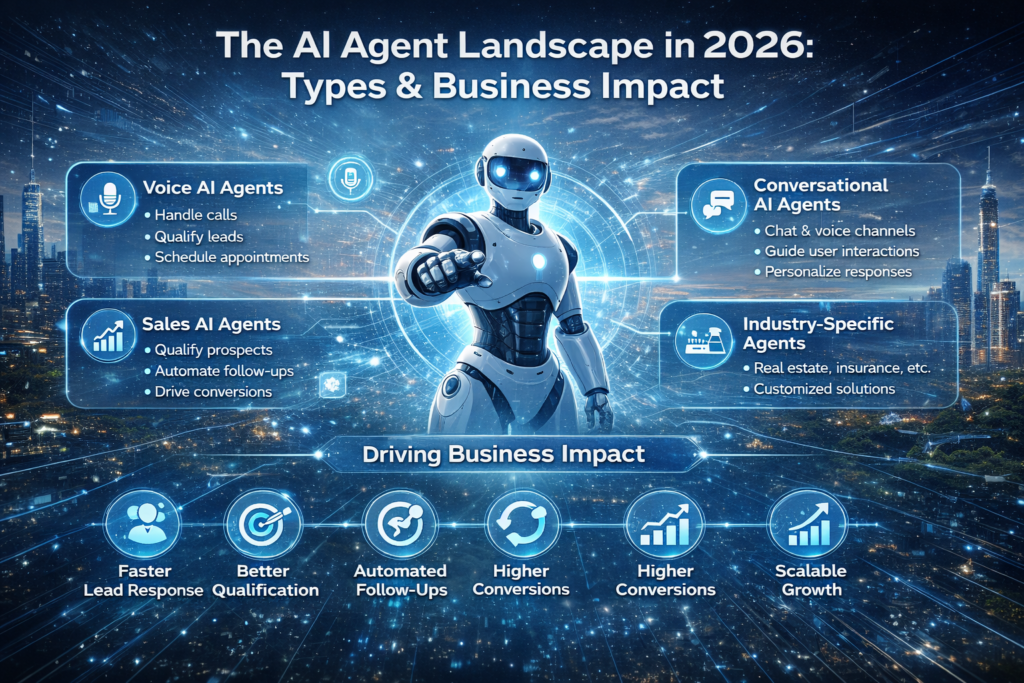
The AI Agent Landscape represents the expanding system of AI agents which execute essential business functions through their ability to conduct communication and make decisions and evaluate leads and streamline work processes.
These agents include:
- Voice AI agents
- Conversational AI agents
- Sales AI agents
- Industry-specific AI agents
- Autonomous workflow agents
The function of AI agents as virtual team members enables them to operate continuously without experiencing any physical exhaustion.
If you’re new to AI agents, understanding what an AI agent does for modern businesses will give you a strong foundation.
Why the AI Agent Landscape Is Expanding in 2026
The AI Agent Landscape is expanding because of three primary reasons which drive increasing adoption throughout various industries.
1. 24/7 Customer Expectations
Customers expect instant responses. AI agents eliminate waiting times and ensure no opportunity is missed. Businesses that implemented intelligent call systems are already seeing measurable improvements in sales and service performance, as explained in how AI call centers are transforming sales and service.
2. Revenue-Focused Automation
Modern AI agents don’t just answer questions — they actively drive conversions.
Conversational systems now guide prospects through the buying journey, qualify intent, and automate follow-ups. The future of conversational AI for sales shows its current development through its impact on sales operations.
The AI Agent Landscape is moving beyond support automation and into revenue generation.
Key Types of AI Agents Transforming Businesses
The AI Agent Landscape includes multiple specialized agents built for different operational needs.
Voice AI Agents
Voice AI agents manage both incoming and outgoing calls while they handle lead qualification appointment scheduling and automated follow-up tasks.
The real estate industry employs voice automation technology to handle property inquiries through automatic systems which operate at high volume. For example, AI real estate voice agents are automating calls and leads in 2026, allowing teams to respond instantly while reducing manual workload.
Voice AI ensures businesses never miss a call — and never miss revenue.
Conversational AI Agents
Conversational AI agents operate across chat, voice, and messaging platforms. They handle user intent understanding with contextual answers and personalized answers which they deliver to many users.
If you’re comparing solutions, understanding the difference between tools is important. Our guide on Difference between voice AI vs chatbot — which is better for your business explains how different technologies fit different business goals.
How the AI Agent Landscape Is Driving Business Growth
AI agents are becoming revenue engines rather than simple automation tools.
Here’s how they create measurable impact:
Faster Lead Response
Immediate engagement significantly increases conversion rates.
Better Lead Qualification
AI filters high-intent prospects before passing them to sales teams.
Automated Follow-Ups
The use of intelligent follow-up systems at regular intervals leads to better results in closing deals.
Higher Operational Efficiency
Businesses reduce human workload while increasing productivity and scalability.
The AI Agent Landscape enables companies to scale without proportionally increasing headcount.
The Future of the AI Agent Landscape
By 2026 and beyond, AI agents will become:
- More autonomous
- CRM-integrated
- Multi-channel intelligent
- Industry-optimized
- Predictive in conversation flows
The AI Agent Landscape has progressed from its initial automation stage to develop complete digital workforce solutions.
The companies that implement new technologies before their competitors will achieve better results in operational output and business expansion and financial success.
Final Thoughts
The AI Agent Landscape is transforming how businesses operate, engage customers, and generate revenue in 2026.
Business communication now undergoes a transformation because intelligent agents create new ways to connect through voice automation and conversational sales systems.
Organizations that integrate AI agents today are building a scalable, cost-efficient, and revenue-driven future.
The future of business communication is not just digital — it’s intelligent.