 businessscales
The insurance industry has become one of the most competitive fields that exists today. Every incoming inquiry has potential revenue attached to it. When a phone call is not answered the business loses a chance to connect with customers. The delay in follow-up activities creates a higher likelihood that a competing business will secure the customer deal before the current company does.
The traditional call center system combined with manual follow-up procedures no longer provides sufficient support for organizations that want to boost their policy sales.
The sales process for modern insurance businesses requires the implementation of AI voice automation technology which enables them to create a sales system that operates with increased speed and intelligence and greater capacity.
Let’s explore how.
The Real Problem: Why Insurance Agencies Struggle to Increase Policy Sales
To find effective solutions for your business we must first identify all growth obstacles that currently exist within your organization.
Most insurance agencies deal with:
- High inbound lead volume but limited staff
- Slow response times
- Manual outbound dialing
- Inconsistent follow-ups
- Missed renewal opportunities
- Rising operational costs
Even highly skilled sales teams struggle to maintain consistency at scale.
In insurance sales, speed is everything. People who request insurance quotes for auto, health, life, or home insurance, will usually review multiple insurance companies. The agency that responds first — and engages meaningfully — significantly increases its closing probability.
AI voice automation technology produces measurable results.
The beginner can learn about the subject by first examining this basic foundation here:
What Is an AI Call Agent and How Does It Work?
What Are AI Voice Agents in Insurance?
AI voice agents are intelligent automated calling systems powered by conversational AI and machine learning.
Unlike traditional robocalls, they can:
- Understand natural language
- Ask dynamic follow-up questions
- Respond contextually
- Qualify leads
- Book appointments
- Route hot prospects to human agents
The system operates as a virtual sales assistant which provides continuous support throughout the day because it never requires rest.
To understand the technology that powers this system, please read: What Is Conversational AI? Why Top Companies Are Adopting It Worldwide
1. Instant Lead Engagement: The Fastest Way to Increase Policy Sales
The speed at which businesses respond to new leads affects their ability to convert those leads into customers.
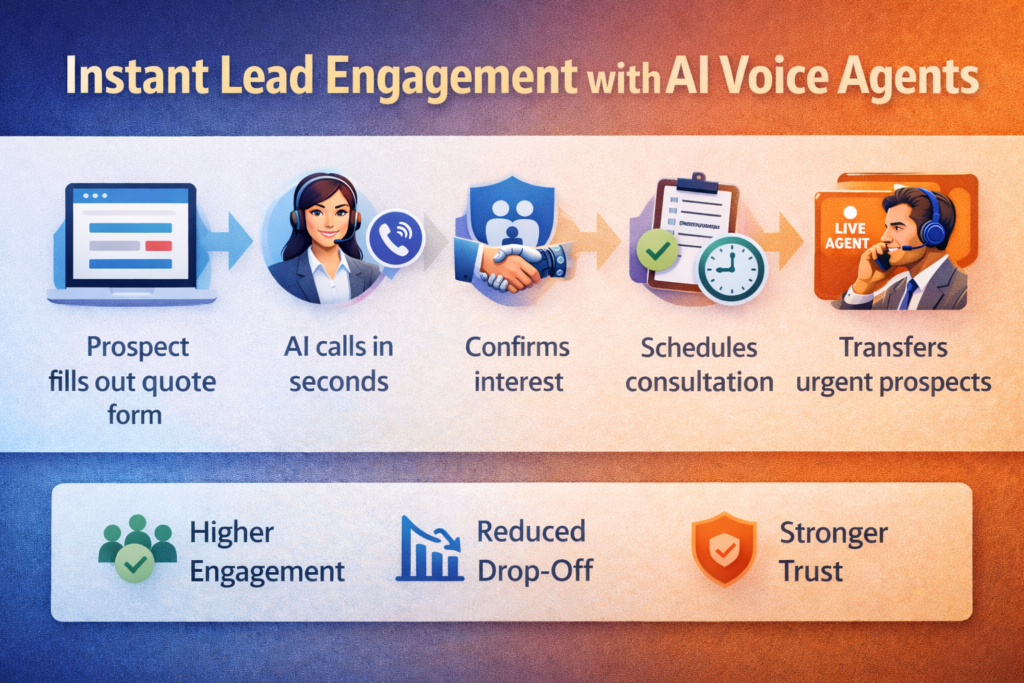
When a prospect fills out a quote form on your website or landing page, AI voice agents can:
- Call within seconds
- Confirm interest
- Gather key policy details
- Schedule a consultation
- Transfer urgent prospects to a live agent
The system provides immediate assistance to prospects who would otherwise wait hours until they receive a callback.
This leads to:
- Higher engagement rates
- Reduced lead drop-off
- Stronger brand trust
- Better first impressions
Fast response alone can significantly increase policy sales.
2. Automated Outbound Prospecting at Scale
Insurance growth doesn’t only depend on inbound leads. Outbound outreach is equally critical.
AI voice agents can automate outbound campaigns for:
- Policy renewal reminders
- Cross-selling additional coverage
- Upselling premium plans
- Re-engaging dormant leads
- Following up on incomplete applications
AI systems possess the capability to make thousands of calls throughout the day which human agents cannot sustain.
The system employs outbound automation to guarantee that every lead remains active within your CRM system.
3. Intelligent Lead Qualification Improves Close Rates
Not every insurance lead is ready to buy. Some customers search for the best price while others want to end their current contracts.
AI voice agents ask structured qualification questions like:
- What insurance coverage do you need?
- What date does your current insurance policy end?
- What is your estimated coverage budget?
- Are you planning to switch providers soon?
The system uses incoming data to classify leads according to their emergency levels and their likelihood of making purchases.
This allows:
- Sales agents to focus only on serious buyers
- Reduced time wasted on low-quality prospects
- Higher closing rates per agent
- Improved pipeline efficiency
Better qualification directly supports agencies looking to increase policy sales efficiently.
You can also explore how AI supports sales performance in detail here: How Conversational AI for Sales Is Shaping the Future in 2026
4. 24/7 Availability Without Increasing Payroll
Insurance leads don’t only come during office hours.
Many quote requests happen:
- Late evenings
- Weekends
- Holidays
The process of hiring staff members who work throughout the day presents high costs and complex personnel management challenges.
AI voice agents function continuously throughout the day without any interruption to their service. That means:
- Zero missed inquiries
- Immediate responses
- Consistent customer experience
- Higher booking rates
This always-on availability dramatically improves policy acquisition opportunities.
5. Automated Follow-Ups That Build Trust and Drive Conversions
Research shows that multiple follow-ups are often required before closing a policy sale.
Yet many agencies struggle with:
- Second or third follow-up calls
- Quote reminders
- Renewal notifications
- Long-term nurturing
AI voice agents automate structured follow-up sequences, ensuring consistency.
They can:
- Remind prospects about pending quotes
- Notify customers about renewal deadlines
- Offer policy upgrades
- Reconnect with inactive leads
Consistency builds familiarity. Familiarity builds trust. Trust increases conversions.
6. Data-Driven Sales Optimization
AI systems offer their primary benefit through the availability of current operational performance metrics.
Agencies gain insights into:
- Call answer rates
- Lead qualification percentages
- Appointment booking ratios
- Script effectiveness
- Conversion trends
The agencies use these insights to enhance their messaging and achieve better results in their marketing campaigns.
The decision-making process now relies on data instead of using previous experience to determine what will succeed
7. Reduced Operational Costs While Scaling Revenue
Managing a traditional call center involves:
- Hiring costs
- Training expenses
- Ongoing supervision
- High payroll commitments
AI voice automation reduces overhead while increasing outreach volume.
This creates a powerful combination:
Lower operational cost + Higher engagement speed + Improved conversion rates = Sustainable growth.
Real Impact: What Insurance Agencies Experience
Insurance agencies implementing AI voice automation often report:
- Faster response times
- More qualified appointments
- Increased cross-sell opportunities
- Higher renewal rates
- Improved agent productivity
- Scalable revenue growth
AI does not replace human agents.
Instead:
- AI handles repetitive outreach
- Human agents focus on closing high-value deals
This collaboration creates a scalable and efficient sales ecosystem.
Is AI Voice Automation Right for Your Agency?
If your agency is experiencing:
- Slow lead follow-up
- Low conversion rates
- Agent burnout
- Missed renewal revenue
- Scaling challenges
Then AI voice automation can systematically help increase policy sales without overwhelming your team.
The insurance industry rewards:
- Speed
- Personalization
- Consistency
AI delivers all three at scale.
Final Thoughts
Insurance agencies that rely solely on manual outreach risk falling behind competitors who automate intelligently.
AI voice agents provide:
- Instant engagement
- Automated outbound calling
- Smart qualification
- 24/7 responsiveness
- Data-backed optimization
If your mission is clear — to increase policy sales — integrating AI voice technology is not just an upgrade.
It’s a long-term strategic growth decision.
The agencies that adapt today will dominate tomorrow’s insurance market.