 businessscales
Customer communication has changed. No one wants to waste their time waiting, repeating their words, or listening through endless IVR options before reaching the right person. This shift explains Why Businesses Are Adopting Voice AI —to deliver faster, smarter, and more human-like interactions that respect customers’ time.
This change in customer behavior is reason enough for companies to adopt Voice AI faster than ever in various sectors such as real estate, insurance, car dealerships, healthcare, finance, e-commerce, logistics, and customer support.
AI Voice Agents can take calls right away, know what the caller wants, classify the leads, and interact with the customers in a human-like wWhy Businesses Are Adopting Voice AI inay—without the delay of human intervention. In 2026, companies will not be adopting Voice AI just for the novelty of it, they will be treating it as a core part of their operations.
The article will cover the reasons for this change, the places where Voice AI is being used and its impact on the future of operations.
What Is Voice AI in Business Communication?
Voice AI is an artificial intelligence technique that can comprehend verbal communication and provide human-like replies instantly.
Unlike conventional IVR or automatic bots, Voice AI relies on:
- Natural Language Processing (NLP)
- Speech recognition
- Context understanding
- Machine learning
The result is human-like phone conversations that feel smooth, fast, and intelligent.
This same technology powers solutions like AI Real Estate Voice Agent systems, which automate property inquiries, lead qualification, and follow-ups without manual effort.
Why Businesses Are Adopting Voice AI in 2026
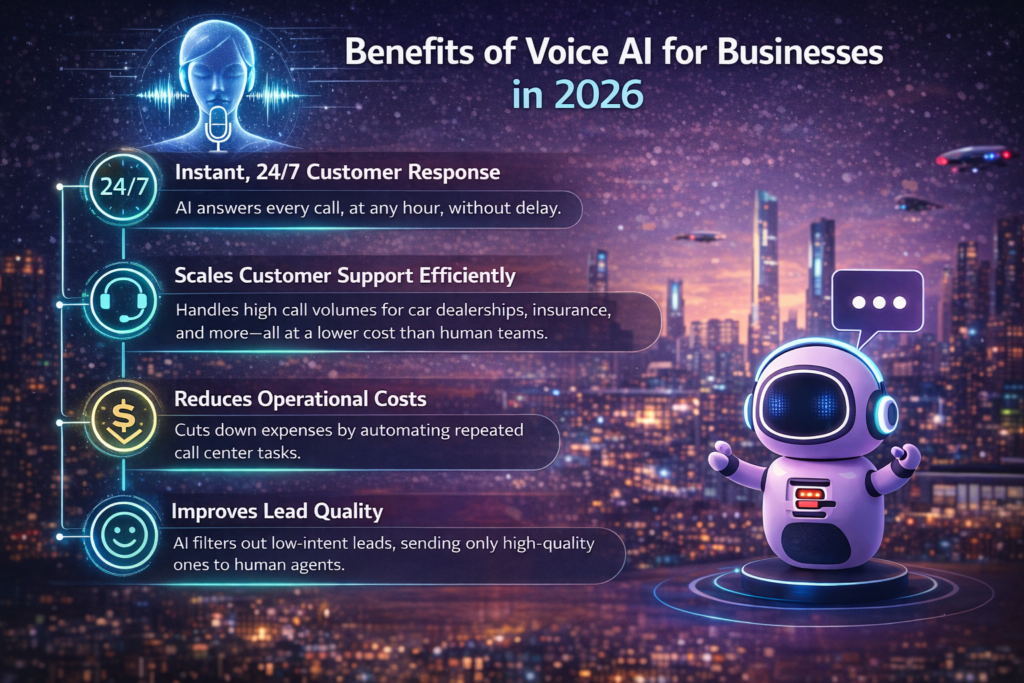
The adoption of Voice AI is driven by real operational needs, especially in insurance firms and car dealerships where response time directly impacts revenue.
1. Customers Expect Instant Responses
Speed is no longer an option.
In industries like insurance and car dealerships, delayed responses often mean lost customers. An AI agent for insurance picks up every single call in no time—day or night. It doesn’t matter if it’s a question about sales, a request for support, or booking an appointment, the customer receives a reply right away.
This one aspect accounts for a significant portion of the reason for the widespread adoption of Voice AI among businesses in customer-interaction segments.
2. Human Teams Can’t Scale Like Voice AI
Hiring more agents increases costs, training time, and management complexity. Voice AI scales instantly.
One AI system can:
- Handle hundreds of calls at the same time
- Work without breaks
- Maintain consistent quality
For companies with rapid growth or fluctuating seasons of calls, Voice AI is the technology that is more trustworthy than hiring and training human staff.
3. Why Businesses Are Adopting Voice AI to Cut Down on Operational Expenses
Call centers are expensive. Voice AI automates repetitive conversations such as:
- Lead qualification
- FAQs
- Appointment scheduling
- Status updates
The staff working at the call center and the overhead for each interaction are reduced, yet service quality remains the same.
Many businesses view this cost-efficiency as the main reason for the quick acceptance of Voice AI over chatbots within the market.
4. Voice AI Improves Lead Quality
Voice AI doesn’t just answer calls. It asks smart questions.
By gathering intent, budget, urgency, and preferences, Voice AI filters out low-intent inquiries and forwards only high-quality leads to human teams.
Industries like real estate already rely heavily on this approach through AI voice agents that qualify prospects before agents engage. For insurance companies, it asks about coverage needs, budget, and policy timelines. For car dealerships, it gathers vehicle preferences, financing interest, and purchase urgency.
5. Natural Conversations Build Trust
The voice channel is warmer than the text one.
Customers feel less embarrassed when explaining their problems over the phone rather than writing them down or getting the assistance of a bot. Modern Voice AI can perceive emotions, hesitations, and even understand the speaker’s intention, thus contributing to human-like interactions.
One of the emotional factors that influence human priority for Voice AI over chat automation is that businesses are indeed adopting Voice AI.
Industries Leading Voice AI Adoption
Voice AI is not confined to a single industry. Its adoption spans across industries.
Real Estate
AI Real Estate Voice Agent handles property inquiries, lead qualification, and instant follow-ups.
Insurance Industry
Voice AI handles policy inquiries, renewals, claim status updates, and lead qualification—reducing agent workload and improving response times.
Car Dealerships
Voice AI manages vehicle inquiries, schedules test drives, follows up on leads, and answers after-hours calls.
Healthcare
The processes of appointment scheduling, patient reminding, and after-hours inquiries are automated safely and efficiently.
Banking and Finance
Voice AI takes over the customer who wants to check the balance, loan pre-qualification and customer verification.
E-Commerce
Instantaneous virtual voice assistance is for order tracking, return requests, and product-related questions.
Logistics and Services
Service and delivery become faster with no chance of errors made in coordination and scheduling.
How Voice AI Works Alongside Human Teams
Voice AI does not take over the jobs of human staff.
The AI handles:
- First contact
- Basic questions
- Qualification
- Routing
Humans handle:
- Complex negotiations
- Emotional conversations
- Deal closing
The blended approach not only saves time but also enhances human interaction.
The Future of Voice AI in Business
By the year 2026 and beyond, Voice AI will steadily become even smarter and context aware to the point of being intimately linked with the CRM systems, analytics tools, and customer data platforms.
Businesses adopting Voice AI early gain:
- Faster response times
- Better customer experience
- Higher conversion rates
- Competitive advantage
Those putting off the adoption will struggle to meet the customer expectations.
Conclusion
The question regarding the adoption of Voice AI by businesses boils down to one word: effectiveness.
It is a time saver, a cost reducer, an enhancer, and a plug-and-play solution that spans multiple industries easily. Voice AI has become an integral component in modern communication strategies from real estate to healthcare to finance.
Voice AI has already established its dominance in the present market scenario and it is also the future that all the businesses are moving towards, no matter how tough the journey and now.