 businessscales
The integration of AI technology has evolved significantly and now it is no longer limited to deploying chatbots that only answer some questions. Moreover, currently, companies are introducing systems that will not only think and make decisions but also act and improve themselves. This type of technology is called AI agents.
So, what does an AI agent do in real business terms?
An AI agent in a business context is a silent but effective partner who constantly monitors the situation, analyses the objectives, selects the best alternative, carries out the actions through different systems, and later on, gets informed by the outcomes. Generally, all this is carried out without any human intervention. Traditional automation is quite different from AI agents in that they can manage complexity, unpredictability, and real-time decision-making.
AI agents are silently and gradually making their presence felt in the form of modern operations—their roles range from AI call agents that are conversant with customers to voice AI systems that take care of sales pipelines.
What Does an AI Agent Means in Simple Business Terms?
An AI agent is an automated software system whose primary function is to accomplish specific aims through:
- Keeping a watch on its environment (data, conversations, events)
- Selecting among different alternatives by employing AI models
- Taking actions across tools and platforms
- Educating itself and getting better with time
An AI agent does not just seem like a digital worker who is always around, works under the given objectives, and switches according to the results but rather like a human who can freely implement a script.
The same technology that empowers:
- AI call agents
- Voice AI assistants
- Conversational AI platforms
What Does an AI Agent Do in a Real Business Environment?
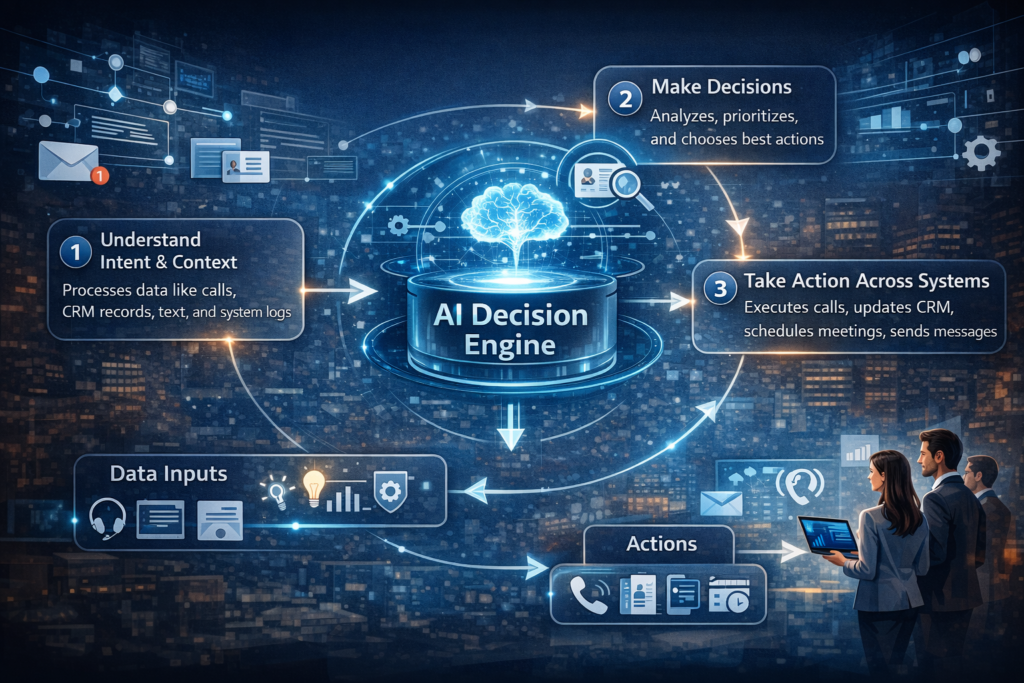
Viewing an AI agent’s functioning in an end-to-end manner is necessary to comprehend what it does rather than merely its interface.
1. Discern Intention and Environment
To grasp the situation and the action needed, AI agents process such input as voice calls, text, CRM data, and system logs.
This is especially visible in AI call centers, where agents understand caller intent, sentiment, and urgency in real time
2. Make Decisions Without Waiting for Humans
Unlike rule-based automation, AI agents decide dynamically.
Examples:
- Which lead should be called first?
- Should a call be transferred or resolved automatically?
- Is this inquiry sales-ready or support-related?
This decision layer is what separates AI agents from basic chatbots
3. Take Action Across Systems
AI agents don’t just respond—they act.
They can:
- Place or receive phone calls
- Update CRM records
- Send follow-up messages
- Schedule meetings
- Trigger workflows
This is how AI call agents ensure no inquiry is missed in high-volume automotive businesses. AI Call Agents in Car Dealerships capture every opportunity.
4. Learn From Outcomes and Improve
A defining feature of AI agents is feedback learning.
They track:
- Call outcomes
- Conversion rates
- Customer responses
- Drop-off points
Over time, they refine scripts, timing, and decision paths—something traditional automation cannot do.
Where Businesses Are Using AI Agents Today
AI agents are already embedded across industries, not as experiments—but as revenue and efficiency drivers.
Sales and Lead Management
AI agents qualify leads, follow up instantly, and route prospects correctly—reshaping real estate, where speed drives conversions. AI Call Agents for Real Estate Lead Management ensure prospects are contacted instantly and never missed.
Customer Support and Call Canters
AI agents resolve common issues, escalate complex cases, and operate 24/7 without fatigue
Insurance and Financial Services
AI agents handle policy inquiries, claims follow-ups, reminders, and verification calls at scale
Real Estate Operations
From inquiry handling to site visit scheduling, AI voice agents are becoming virtual front-desk teams.
AI Agent vs AI Call Agent vs Voice AI: What’s the Difference?
Many businesses confuse these terms. Here’s the clarity:
- AI Agent – The brain and decision-maker (logic, reasoning, learning)
- AI Call Agent – An AI agent specialized in phone conversations
- Voice AI – The interface that enables speech input and output
This distinction is very important when it comes to selecting a solution that is appropriate for your company.
Key Benefits of Using AI Agents
Understanding what does an AI agent do also means understanding why businesses adopt them:
- Faster response times
- Lower operational costs
- 24/7 availability
- Consistent customer experience
- Scalable operations without hiring pressure
- Making decisions based on data
AI agents are not team replacements; they eliminate delays.
Challenges Businesses Should Be Aware Of
The use of an EEAT class that matches the above-mentioned principles would be transparent and accountable from the outset.
Key considerations:
- Data quality directly affects agent performance
- Human oversight is still essential
- Clear boundaries must be defined for decision authority
- Security and compliance must be built in from day one
The AI agents that work best are those that have proper governance and not just power unleashed.
Frequently Asked Questions (FAQs)
1. What does an AI agent do that a chatbot cannot?
AI agents are capable of choosing, communicating through different systems, and improving their abilities gradually. Chatbots are confined to certain interactions and provide only pre-programmed answers.
2. Are AI agents suitable for small businesses?
Definitely, Many AI agents are adaptable in size and cost and thus affordable ensuring sales and support for customers can be automated.
3. Will AI agents take over the jobs of human workers?
Definitely not; the slow repetitive and mundane tasks are the ones done by AI agents so that humans may concentrate on strategy, relationship-building, and making complex decisions.
4. Can AI agents work with existing CRMs and tools?
Yes. Most AI agents will connect through APIs with CRMs, telephony systems, and software used in business.
5. Are AI agents safe to use in customer interactions?
AI agents backed up with rules of governance, monitoring, and fallback are safe and sometimes even more consistent than human operators.
Final Thoughts
So, what does an AI agent do for modern businesses?
The agent is a listener, thinker, decider, doer, and learner, not only at an amazing speed and without getting tired but also with a noticeable impact on the business. AI agents are indeed becoming indispensable and are, in fact, taking the place of traditional layers in the sales, service, and customer experience sectors.
The early adopters are the ones who will benefit the most from the speed, insight, and resilience that come with it. On the other hand, those who are not ready to embrace the change will have to deal with the consequences of being left behind.