 businessscales
Artificial intelligence has transformed the methods that investors use to assess and manage their property portfolios. The implementation of AI for Real Estate Investment in 2026 has become essential for businesses.
The property markets today experience rapid changes because. The property market experiences rapid price fluctuations and sudden shifts in buyer demand which leads to investment opportunities that last only a few days. The combination of manual research and broker advice and outdated reports no longer meets research needs.
AI-powered systems provide investors with three tools that work together to create predictive insights and automated communication and real-time analytics which help businesses increase their profits while minimizing their potential losses.
The explanation of AI for Real Estate Investment functions through its internal processes is needed.
Let’s break it down in detail.
Understanding AI for Real Estate Investment
AI for Real Estate Investment refers to the use of artificial intelligence, machine learning, predictive analytics, and automation tools to:
- Analyze massive real estate datasets
- Predict future property values
- Identify high-growth markets
- Evaluate investment risk
- Automate investor communication
- Optimize portfolio performance
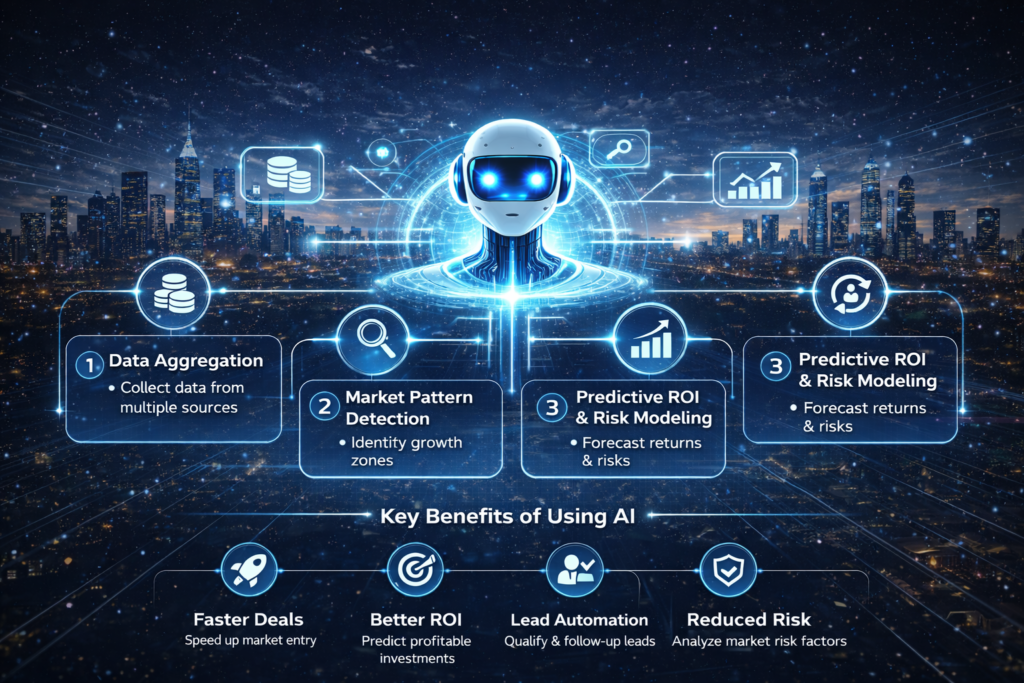
The system uses AI platforms to analyze data from multiple sources instead of traditional methods which involve manual listing comparisons and spreadsheet evaluations.
The result creates better investment decisions through three improvements which produce faster investment processes and smarter investment processes and more confident investment processes.
The Foundation: Data Is Everything
The power of AI begins with data.
Modern AI investment platforms collect and analyze information from:
- Historical property transactions
- Rental performance records
- Local economic indicators
- Interest rate trends
- Infrastructure development plans
- Population migration statistics
- Neighborhood crime and school data
- Online property search behavior
Traditional investors might look at a handful of these factors. AI evaluates all of them simultaneously.
The system establishes its correct prediction through processing additional data.
Step 1: Market Pattern Detection
AI systems use machine learning algorithms to detect patterns that human beings cannot see.
For example, AI can identify:
- Neighborhoods which show early indications of rapid value growth
- Rental markets which experience increasing demand but face supply challenges
- Locations which will gain advantages from future infrastructure development
- Investment zones which experience population changes
Investors who identify these patterns beforehand can enter markets which will see price increases.
The ability to forecast future events represents the main benefit which AI technology provides to real estate investors.
Step 2: Predictive ROI and Risk Modeling
The AI platforms use predictive modeling to determine potential financial returns after they find valuable business opportunities.
These systems evaluate:
- Expected appreciation rates
- Cash flow projections
- Vacancy risk probability
- Market volatility exposure
- Sensitivity to interest rate changes
Investors receive forecasts which depend on probability instead of future performance predictions.
The approach saves money because it reduces emotional choices and protects against dangerous investment decisions.
Step 3: Intelligent Property Valuation
The most typical investment error consists of paying too much for a property.
The AI system solves this challenge by using current market information to compare the targeted property with thousands of similar properties.
It considers:
- Comparable sales
- Market timing
- Local growth signals
- Buyer demand trends
- Development activity
This ensures pricing decisions are backed by data — not assumptions.
Step 4: Automation of Lead Management and Communication
In real estate investing, speed matters.
A delayed response to a motivated seller or buyer can cost thousands — or even millions — in lost opportunity.
AI-powered communication systems solve this challenge.
Technologies like those explained in What Is an AI Call Agent and How Does It Work?
allow investors to automatically:
- Answer inbound inquiries
- Qualify prospects
- Collect key property details
- Schedule meetings
The monitoring systems function throughout the entire week which guarantees that all leads will be captured.
Step 5: AI Voice Automation for Real Estate Investors
In 2026, voice AI will become a critical component of investment operations.
Advanced solutions such as those described in AI Real Estate Voice Agent: Automating Calls, Leads & Inquiries in 2026 enable investors to:
- Respond instantly to seller calls
- Pre-screen investment opportunities
- Automate follow-ups
- Reduce administrative costs
Voice AI increases conversion rates because response time directly influences deal success.
Step 6: AI Agents for Portfolio Growth
AI doesn’t stop at acquisition. It continues optimizing your portfolio.
It can:
- Recommend diversification strategies
- Identify underperforming properties
- The system recommends refinancing solutions
- Optimize rental pricing dynamically
- Forecast long-term portfolio performance
Real estate teams using intelligent automation systems — like those discussed in How AI Agents for Real Estate Help Teams Become More Productive – scale operations significantly faster than traditional teams.
The Role of Conversational AI in Investor Experience
AI is not limited to data analysis. It also enhances customer and investor interaction.
Modern conversational AI systems — similar to those explained in What Is Conversational AI & Why Top Companies Are Adopting It Worldwide? — allow real estate businesses to:
- Provide instant answers to investment queries
- Guide buyers through property options
- Personalize property recommendations
- Improve client engagement
This improves trust, satisfaction, and deal conversion rates.
Why AI for Real Estate Investment Is Dominating in 2026
The current power of AI technology results from multiple factors which enable its implementation. Several factors make AI especially powerful today:
- Real-Time Data Integration: The AI system now receives ongoing updates which include current market information.
- Improved Machine Learning Accuracy: Models learn from every transaction, improving prediction reliability.
- Full Automation Capabilities: AI now handles both analytics and operational workflows.
- Scalability: Investors can manage larger portfolios without expanding staff.
Common Misconceptions About AI in Property Investing
“AI replaces human investors.”
False. AI supports decision-making but does not replace strategic thinking.
“AI is only for large investment firms.”
Not anymore. In 2026, AI tools are accessible to individual investors and small teams.
“AI predictions are always perfect.”
AI reduces uncertainty but still relies on market conditions. Human oversight remains essential.
Competitive Advantage: Investors Who Use AI vs Those Who Don’t
Investors using AI benefit from:
- Faster market entry
- Better deal qualification
- Reduced risk exposure
- Higher operational efficiency
- Increased lead conversion
Those relying solely on traditional research may struggle to compete in fast-moving markets.
The Future of AI for Real Estate Investment
The next evolution of AI in real estate will include:
- AI-powered negotiation assistants
- Automated due diligence analysis
- Smart contract integrations
- Blockchain-linked property verification
- Hyper-personalized investment dashboards
The rising competition forces market participants to adopt artificial intelligence, which will create a gap between typical investors and top-performing investors.
Final Thoughts
The final thoughts about artificial intelligence in real estate investment demonstrate its ability to change how properties undergo analysis, acquisition, and management.
The complete range of AI system capabilities now includes predictive analytics and voice automation features. AI systems now provide:
- Data-driven opportunity detection
- Risk forecasting
- Instant lead engagement
- Portfolio optimization
The most successful property investors in 2026 will require both market expertise and artificial intelligence capabilities.
The real estate strategy of your business needs artificial intelligence integration because it will help you achieve better decision-making and faster growth and higher returns on investment. The future needs your business to adopt this solution.