 businessscales
Sales conversations now happen at all times because businesses operate outside work hours and do not restrict their agents to specific times and their salespeople now use conversational AI. Buyers in 2026 need businesses to provide them with immediate responses which deliver appropriate solutions while enabling them to transfer between support agents at any time and through any contact method.
The sales process benefits from conversational AI because it creates smoother pathways which help sales teams build relationships with bigger clients. The need for conversational AI solutions has become essential for businesses because customers now demand immediate service delivery during their sales interactions.
Why Conversational AI for Sales Is Gaining Momentum
Customer behavior has permanently changed. Prospects conduct their research independently while they contact businesses at random times and they expect businesses to provide immediate benefits during each interaction.
Traditional sales systems have three main problems which include their inability to respond quickly and their failure to capture incoming leads and their lack of effective methods for following up with customers. The main explanation for this problem appears in how AI call centers are transforming sales and service, where speed and availability directly influence revenue outcomes.
Businesses need to use more than manual processes when they face rising volumes because their current method leads to worse customer service.
What Conversational AI for Sales Actually Is
The AI system allows users to engage in natural conversations through voice and digital channels which the system can understand and respond to with proper actions.
Conversational AI systems extend their capabilities beyond standard chatbots because they comprehend user needs and they generate dynamic responses which modify their output based on the current dialogue. This function operates in direct connection with the comprehensive definition provided at What is an AI call agent and how does it work?
The system operates as an everlasting sales assistant because it provides unending service throughout all periods of time.
How Conversational AI for Sales Works in Real Sales Teams
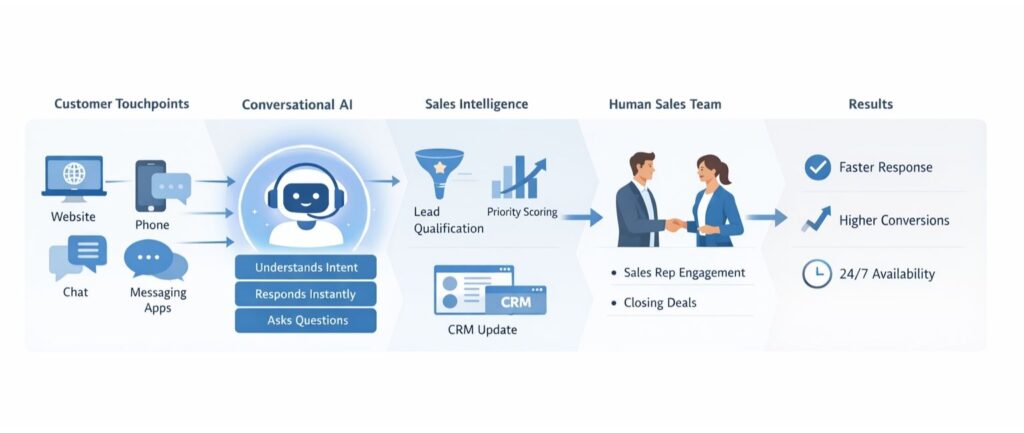
Instant Lead Engagement
The system leads contact with potential customers as soon as they complete a form or start a chat or contact a business through phone. This prevents lead drop-offs caused by delayed callbacks.
This same principle explains why AI call agents in car dealerships never miss a customer inquiry, even during peak hours or after business hours.
Smart Lead Qualification Through Conversation
The platform uses conversational AI to conduct interactive interviews that ask suitable questions. It identifies intent, urgency, and readiness through dialogue.
The current method has started to change real estate operations because it implements AI call agents in real estate lead management. The system achieves faster customer qualification which results in increased conversion rates.
Supporting Sales Teams Without Replacing Them
The system uses conversational AI to manage common initial contacts which allows sales representatives to concentrate on essential negotiations and completion of deals.
This balance between automation and human expertise is a key reason why companies are increasingly investing in what conversational AI is and why top companies are adopting it worldwide.
Why Businesses Are Adopting Conversational AI for Sales in 2026
Businesses choose to invest in conversational AI because it provides sales solutions which drive their growth in the upcoming year 2026. Sales leaders are not adopting conversational AI for novelty—they are adopting it for measurable results.
The main benefits of the system include the following features:
- Faster response times
- 24/7 lead engagement
- Reduced manual follow-ups
- Consistent sales messaging
- Cleaner CRM data
Statista reports that consumer opinions on use of conversational AI show that they prefer AI-based dialogues which offer them quick and easy solutions through automated systems.
Conversational AI vs Voice AI vs Chatbots
Business organizations frequently mix up conversational AI technology with voice AI technology and chatbot systems.
Conversational AI serves as the intelligence component which processes contextual information and discovers user intentions. Voice AI enables users to communicate through speech while chatbots operate through established conversational frameworks.
Industries Seeing Strong Results Today
The sales industry uses conversational AI technology to achieve business results across multiple sectors including SaaS, real estate, insurance, automotive, and enterprise sales.
In insurance, conversational and voice AI are handling policy inquiries, renewals, and follow-ups at scale—use cases explored further in AI voice agents for insurance companies.
What Businesses Should Consider Before Implementation
The implementation of conversational AI achieves its maximum effectiveness through the establishment of clear operational protocols that include necessary control measures.
Businesses should focus on:
- Clean and structured data
- Clear escalation rules to human agents
- Continuous monitoring and optimization
- Built-in security and compliance
Organizations that treat conversational AI as a strategic capability—not just a tool—see the strongest long-term results.
The Future of Conversational AI for Sales
The development of conversational AI will transform from its current form into a sales prediction system which will forecast client requirements while it automatically customizes customer interactions through multiple voice and digital platforms before 2026 ends.
This evolution aligns closely with why businesses are adopting voice AI across industries.
The sales dialogues will become more humanlike through AI technology which eliminates hidden barriers that prevent smooth communication between people.
Frequently Asked Questions
1. What is conversational AI for sales used for?
The system handles lead engagement together with prospect qualification while performing follow-up tasks and enabling sales personnel to engage in natural dialogue.
2. Does conversational AI replace salespeople?
No. The system eliminates repetitive work so sales personnel can dedicate their time to establishing connections and finalizing deals.
3. Can conversational AI integrate with CRMs?
Yes. The majority of platforms establish connections with customer relationship management systems and telecommunications networks and scheduling applications.
4. Is conversational AI effective for inbound sales?
Yes. The system provides immediate customer contact while its intelligent qualification process leads to better inbound conversion results.
5. Is conversational AI safe for customer interactions?
With proper governance and monitoring, it is secure and often more consistent than manual handling.
Final Thoughts
The adoption of conversational AI technology for sales is now necessary in today’s business environment. The 2026 business environment will determine how organizations handle opportunities through their response times and cognitive abilities and operational consistency.
Early adoption of conversational AI technology provides businesses with faster operations and better growth potential and deeper understanding. The companies which postpone their implementation will come to realize that market conditions have changed because they must now compete against rivals who have advanced beyond them.