 businessscales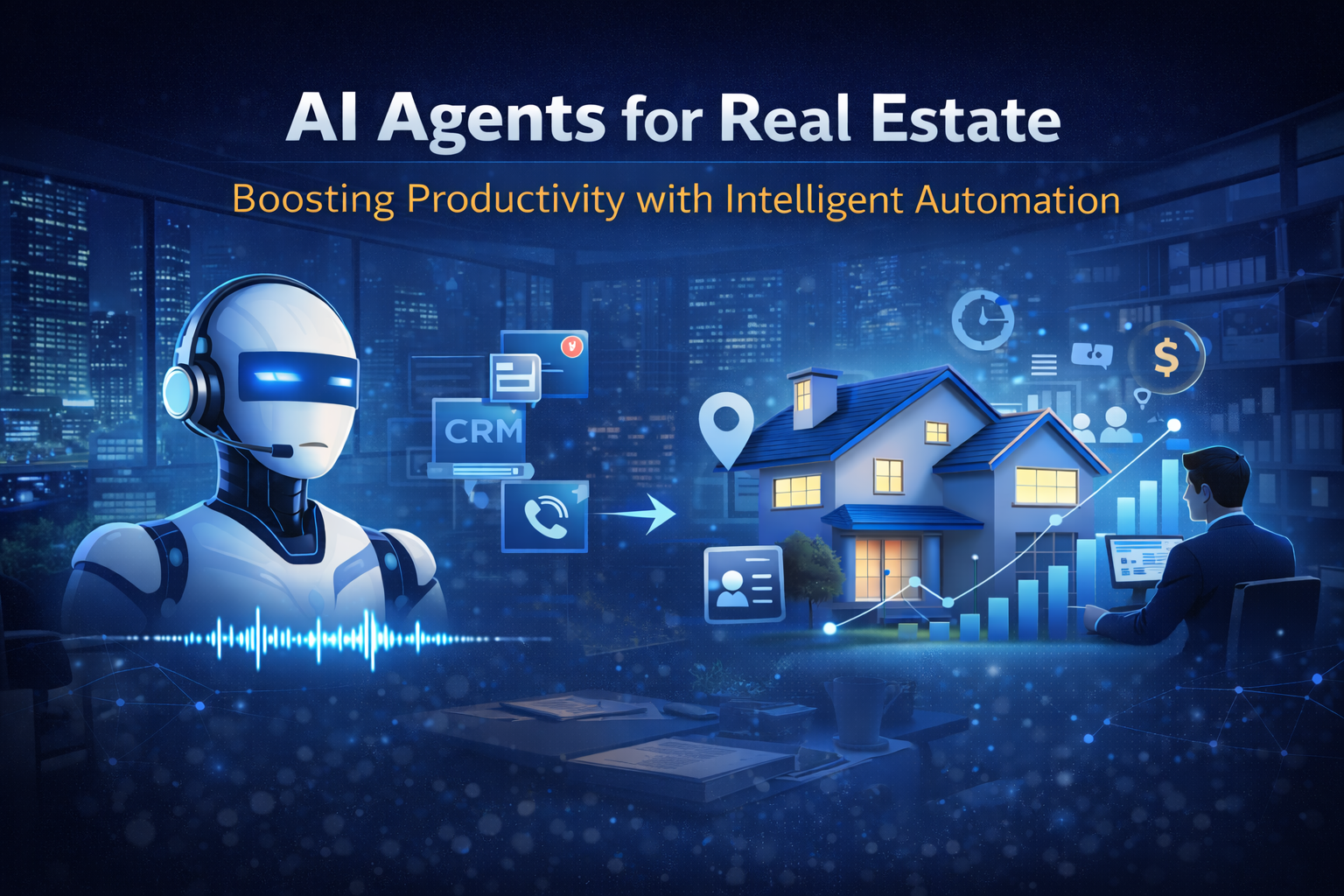
Real estate productivity is rarely limited by talent. Taking the limitations of time, speed, and consistency into account, agents have to manage phone calls, messages, reminders, on-site visit coordination, and CRM updates daily. When these tasks accumulate, even the best teams start to lose their chances.
This is precisely where AI agents for real estate are transforming the way teams work. They handle all the repetitive and time-sensitive tasks while letting the human agents deal with negotiations, relationships, and the closing of deals.
What Are AI Agents for Real Estate?
AI agents for real estate are smart software systems that manage communication, making decisions and performing operational tasks during the sales journey. They are not like simple chatbots, as they do not only depend on the fixed scripts. They analyse intent, choose the next best action, and execute tasks across connected systems.
In an example, an AI agent may be speaking with buyers and sellers using the phone, WhatsApp, SMS, or the website chat and at the same time updating the CRM records, making appointments, and directing the high-intent leads to the agents.
To understand the technical foundation behind this, you can read What Is an AI Call Agent and How Does It Work?
Why Productivity Breaks Down in Real Estate Teams
The biggest part of the productivity losses occurs between the actions and not during them. A delayed follow-up, a missed call after office hours, or a lead that never gets properly qualified can, without notice, lower conversions.
Common productivity challenges include:
- High lead volumes with limited agent availability
- Time spent on cold or unqualified inquiries
- Manual scheduling and coordination
- Inconsistent CRM updates
- Missed follow-ups during peak hours
These are workflow problems—not performance issues. AI agents for real estate are built to eliminate these gaps.
How AI Agents for Real Estate Improve Daily Productivity
Faster Lead Response at Every Hour
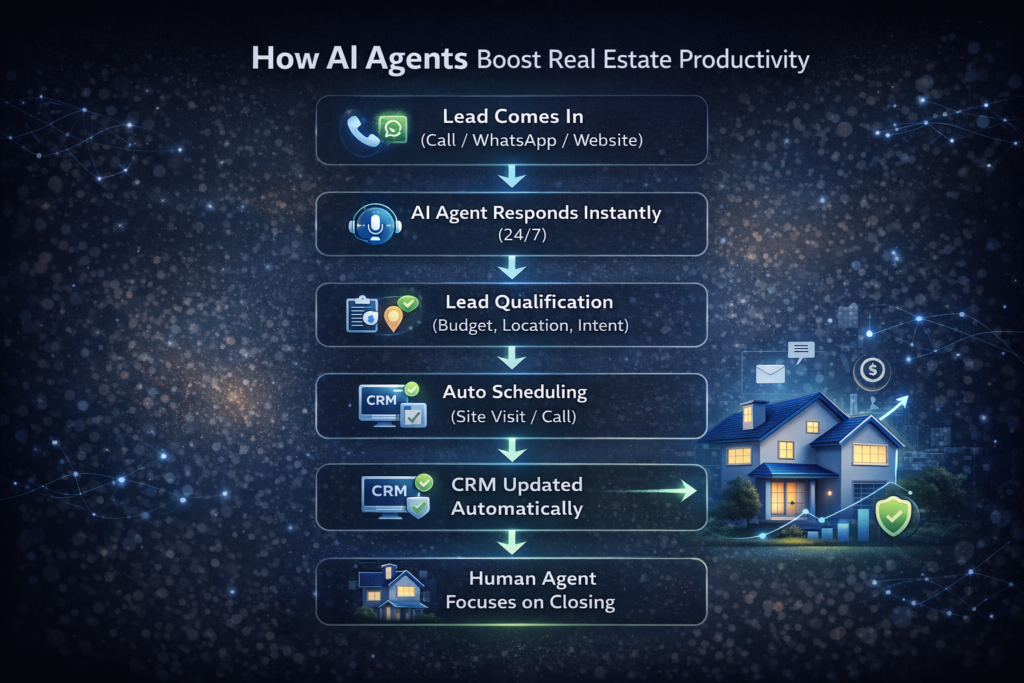
Speed is a major conversion factor in real estate. AI agents are available to reply instantly to incoming calls and messages, even outside office hours. That guarantees that the potential customers are connected when they want it the most.
By not letting there be delays in responses, AI agents are enabling the teams to grab more opportunities without putting in extra workload. This, in turn, is stimulating the use of AI-powered call handling in different industries.
The trend of moving towards AI-powered call handling is not just limited to real estate but rather widespread, as discussed in How AI Call Centers Are Transforming Sales and Service.
Automatic Lead Qualification That Saves Time
Not every inquiry is prepared to perform a transaction. The AI agents carry out the qualification of the leads by posing structured questions about the budget, the location, the type of property, and the time frame for the purchase.
This process helps teams:
- Identify high-intent buyers faster
- Reduce time spent on cold leads
- More effectively prioritize follow-ups
The above-mentioned leads are those that agents concentrate on because they are more likely to be converted.
Effortless Site Visit Scheduling
It often takes up a lot of time that isn’t obvious to people when coordinating property visits. The entire workflow is managed by AI agents who check availability, book appointments, send confirmations, and handle reschedules.
Communication that is not necessary is cut off and schedule is kept neat and organized without human effort.
Consistent CRM Updates Without Manual Work
Accurate CRM data is productivity’s lifeblood; however, it is oftentimes neglected. AI agents carry out the logging of conversations, updating of lead statuses, and attaching of summaries to CRM records automatically.
This creates:
- Better pipeline visibility
- More accurate reporting
- Stronger follow-up discipline
Agents and managers can rely on data without chasing updates.
Multi-Channel Communication From a Single System
Modern buyers use multiple communication channels. AI agents maintain consistent engagement across:
- Phone calls
- SMS
- Website chat
This omnichannel presence means that the response rates go up, and at the same time the pressure on human agents is reduced. For more extensive trends, see Why Businesses Are Adopting Voice AI Across Industries
Where AI Agents Are Actively Used in Real Estate
AI agents for real estate are already embedded across different business models.
- Residential sales teams use them to handle high inquiry volumes
- Commercial real estate firms rely on them for meeting coordination
- Property management companies use them for tenant communication
A practical use case is covered here AI Call Agents for Real Estate Lead Management
AI Agents vs Traditional Automation
Traditional automation goes by the set rules and stops when the situation changes. AI agents adjust, learn, and become better with time.
The main differences are:
- Automation reacts; AI agents decide
- Automation handles tasks; AI agents manage workflows
- Automation remains static; AI agents improve continuously
This flexibility is the major reason AI agents become more effective in ‘real-world’ real estate operations.
Productivity Benefits That Matter to Teams
By embracing AI agents for real estate, teams obtain:
- Faster lead response times
- Higher-quality conversations
- Reduced operational load
- More consistent customer experience
- Better use of agent time
AI agents do not replace human expertise. They remove friction from daily operations.
What to Consider Before Implementing AI Agents
The successful adoption of AI agents requires a defined process and clear objectives.
Key considerations include:
- Clean and reliable data
- Clear escalation rules for human agents
- CRM and telephony integration
- Security and compliance readiness
When these foundations are in place, AI agents deliver long-term productivity gains.
Conclusion
Productivity in real estate depends on speed, focus, and consistency. Manual processes slow teams down and increase the risk of missed opportunities.
AI agents for real estate help teams scale conversations, decisions, and follow-ups without increasing headcount. Teams that adopt AI early gain a clear advantage in efficiency and customer experience.
FAQs
1. Are AI agents for real estate suitable for small teams?
Yes. Smaller teams often benefit the most from automation.
2. Do AI agents replace real estate agents?
No. They handle repetitive tasks so agents can focus on closing deals.
3. Can AI agents integrate with existing CRM systems?
Yes. Most AI agents integrate with common real estate CRMs.
4. Are AI agents safe for customer interactions?
With governance and monitoring, they are reliable and consistent.
5. How quickly can AI agents be deployed?
Most systems can be implemented within days.