 businessscales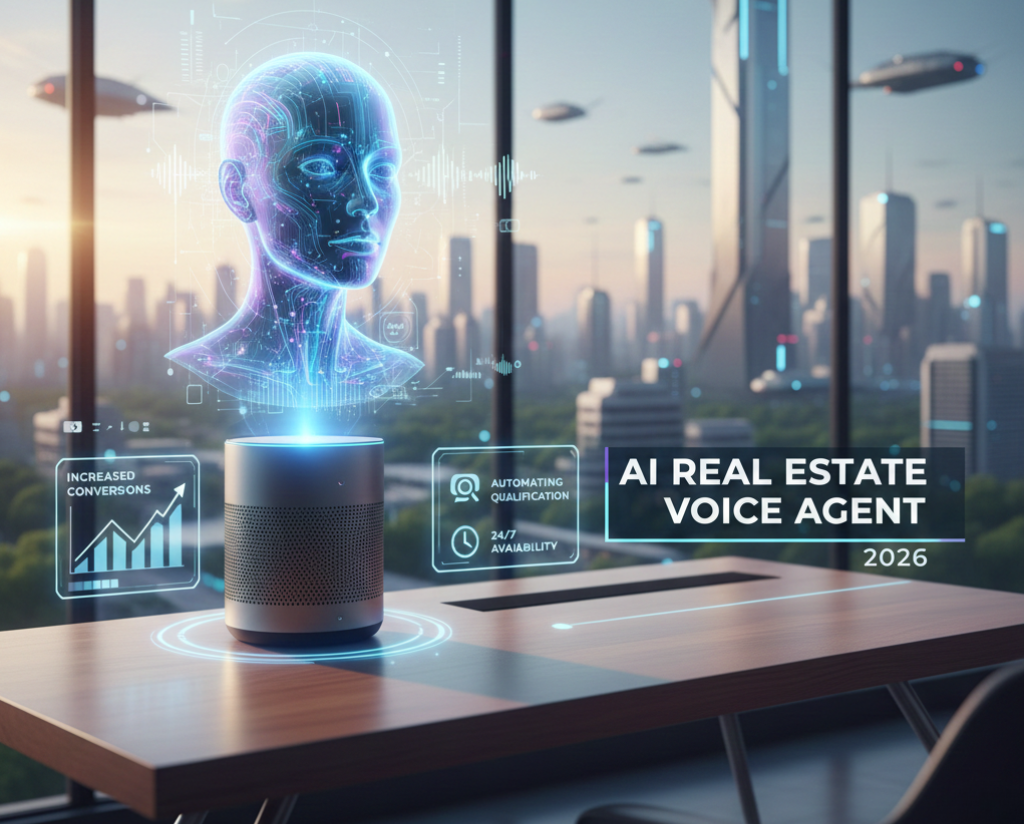
The year 2026 will mark a technological revolution in the real estate sector, the main cause being the swift introduction of artificial intelligence (AI) applications. One of the most astonishing advancements is AI Real Estate Voice Agent which is a device that will not only take care of the phone calls for real estate businesses but will also make the whole process of lead qualification, response time, and customer engagement to be faster, thus, higher in peak quality.
The real estate market will keep on changing and the use of AI Voice Agents will make it easier for the companies to be in the lead, count the leads quicker, and eventually close more sales. This article will take you through the journey of these smart systems to their impact on the real estate industry in 2026 and even further to why your business need these systems from today.
What is an AI Real Estate Voice Agent?
An AI Real Estate Voice Agent is a highly developed virtual assistant equipped with the capabilities of a natural language processing (NLP) and machine learning algorithm to imitate the communication of the customers in the real estate sector. AI voice agents are differen t from the standard call systems or chatbots in that they can talk in and sustain very dynamic and human-like ways, thus, giving a very approachable experience to customers.
The work that these AI agents can do include the following:
- Promptly receiving incoming calls so that no possible customer is lost during the time the calls are coming.
- Administering lead qualification by asking questions that are standard inquiring about budget, property preferences, and timelines.
- Directing the leads of good quality to the proper salespeople so that the salespeople can attend to the needs with higher value.
- Taking care of multiple requests at the same time so that your team does not get overwhelmed during the times when there are a lot of inquiries.
- Leads must be followed up by the sales team promptly and regular communication should be established to maximize the likelihood of conversion.
AI Voice Agents turn out to be a very useful addition to the team in the sense that all human errors are minimized, response time is increased, and overall productivity of the team members gets better, thus the process getting easier.
Advantages of AI Real Estate Voice Agents in the year 2026
In 2026, the AI Real Estate Voice Agent has developed into a necessary component of the digital strategy of the real estate industry. Let us analyze how it supports the enterprises and customers:
1. 24/7 Availability and Instant Response
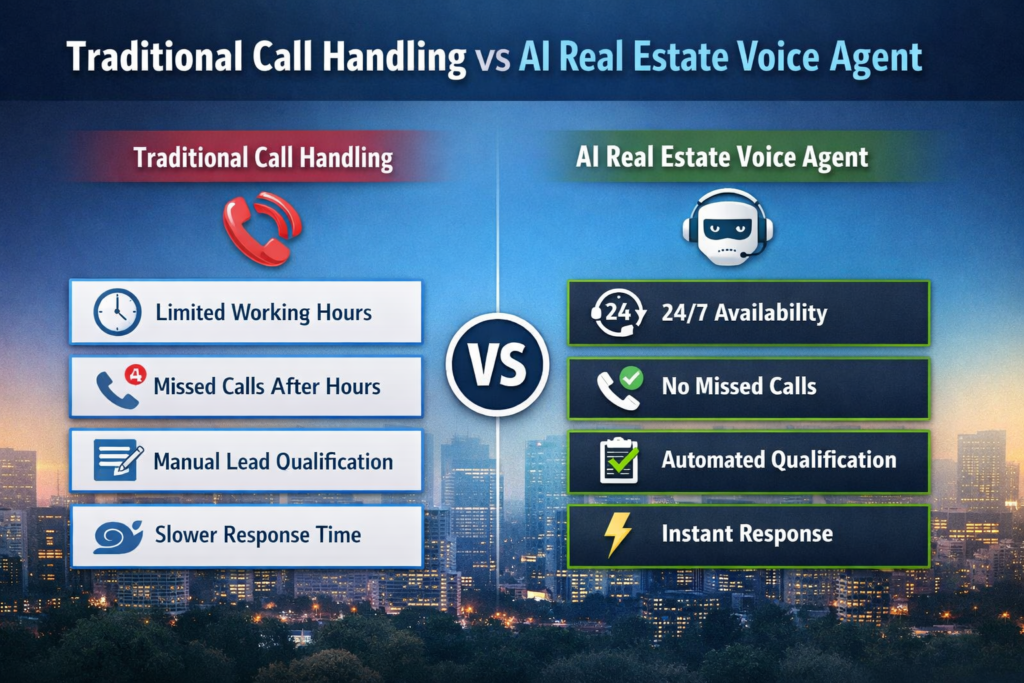
One of the main attributes of the AI Real Estate Voice Agents is the round-the-clock agent service. No matter when the potential customer makes a call-his or her timing could be at midnight or during a crowded open house the AI agent can start talking to him or her instantly. In an environment that values instant communication, AI that picks up calls within three seconds is a huge leap forward in lead generation.
The all-time presence in different time zones, via missed calls or just after-hours questions no longer means that the prospect has been lost. The AI keeps customer satisfaction at the level buyers and sellers are often looking for by giving quick responses which is usually the case that the customers won’t wait too long for their answers.
2. Streamlined Lead Qualification with AI Real Estate Voice Agents
Lead qualification frequently causes a delay in the real estate processing. If there are no proper systems for qualifying leads in place, it might take a lot of time person who is basically not interested in the property or being talked through a long sales process before saying that he/she is not interested to the agent, there is always the risk of draining the energy and wasting the time of the sales team.
In 2026, the AI Voice Agent will be capable of qualifying leads in seconds by asking personalized questions regarding their requirements like the budget, location preferences, property type, and buying timeline. The AI will then evaluate the lead’s potential and pass the high-value pros to the respective agents while keeping the less promising ones for future follow-up along with the nurturing.
AI voice agents have automated the lead qualification process and, thus, have directed your team’s efforts to the very few promising prospects so you can save a lot of time and eventually your lead-to-conversion ratio will be significantly increased.
3. Overflow and High-Volume Inquiries Handling
Real estate teams attract quite a number of inquiries especially during the high seasons or after the marketing campaigns. The high number of calls may lead to missed chances or unsatisfied customers. At this stage, the AI Voice Agent becomes a necessity.
These AI Call Agents for Real Estate can simultaneously manage several inquiries thus guaranteeing that no call goes unanswered even during the busiest times. It can be a matter of answering typical questions related to the listings, making appointments, or just collecting the customer’s information, AI voice agents can control a huge part of your incoming call traffic, letting your agents spend time on more difficult and complex tasks like making deals or showing properties.
4. Scale of Personalized Interactions
In the past, companies were forced to choose between personalized customer service and efficiency. Today, with AI voice agents, real estate firms can deliver personalized service to larger numbers while still maintaining the same service standards. The dialog between AI and voice agents is based on advanced NLP and even though it might be difficult to tell one from the other, it feels quite human-like and natural.
For example a person calling to inquire about a luxury house can be asked about his budget and when he would like to move in, while a first-time homebuyer can receive questions according to his needs. The experience is individualized for every lead which makes him feel appreciated and understood.
In addition, AI voice agents keep on improving continually through their engagement, thus giving more accurate and better insights with each passing day which in turn results in the most personalized conversations.
5. Data-Driven Insights for Better Decisions
AI voice agents have gone beyond conversing with the leads only; they are capable of obtaining valuable data through each interaction. The procedure includes documenting the phone calls, the qualifying questions, and the responses of the customers. This information not only helps your sales force but also gives them pointers on how to improve their follow-up practices, revamp marketing tactics, and even change approaches to selling.
By 2026, the top AI voice agents will furnish KPI dashboards showing the call performance, response times, lead conversion rates, and more, all in real-time. The agents will then develop their skills gradually, making data-based choices and thus getting more and more performance.
How AI Real Estate Voice Agents Work in Practise
1. Lead Qualification and Routing
Just imagine, a possible buyer rings your office late after he/she has seen an online property ad. It is eight o’clock in the evening. The AI Real Estate Voice Agent picks up the phone, asks about the buyer’s budget, preferred location, and the type of house he/she would like, and finally decides whether the buyer is just curious or ready to make an offer. The AI gathers all the answers and either books them into the calendar for a meeting with an agent or an automatic email follow-up, thus certifying them.
The AI passes a very promising lead to a human agent who will either engage in conversation or arrange an in-person viewing of the property.
2. Post-Inquiry Follow-Up
A different case is the period of follow-up after an online campaign. Starting from the moment a potential customer fills out a contact form or shows that he/she is interested in a particular listing, the AI Voice Agent will automatically call back in less than a minute to provide more information, qualify the prospect, and even possibly arrange a meeting.
The AI works so that the lead does not lose the interest or the chance to engage with the business by following up immediately after the inquiry. The agents spend their time on the least possible area of the most promising leads and therefore, they are working on conversions of the highest quality.
Implementing an AI Voice Agent in Real Estate: Best Practices
Below are some important implementation tactics to help an AI Voice Agent reach its full potential:
- Set Clear Objectives: Define the anticipated results from the AI, for example, lead qualification, 24/7 availability, or enhanced customer service. It will direct your choice of the right platform and tools for your business activities.
- Integrate with Existing CRM Systems: Ensure that your AI voice agent is 100% compatible with your present Customer Relationship Management (CRM) system so that all the lead data that matters can be collected and the records updated automatically.
- Watch and Develop: Accumulate and analyze, from time to time, the performance metrics of the AI and the customer comments, to take the necessary adjustments in the AI’s answers, reassess the lead qualification criteria, and ensure that the AI is really helping your team well.
- AI and Human Interaction Balancing: The case when there is a need for it, the smooth transition from the AI agent to a human agent should be guaranteed. The AI could take care of the first contact but human agents must still be present, of course, to make the interaction warmer and friendlier whenever that is the case.
Why Your Business Needs an AI Real Estate Voice Agent in 2026
Getting ahead in the real estate industry means being able to exploit the whole of modern technology. By the year 2026, AI Voice Agents will have gone from being a luxury to a live necessity.
The company that lets AI do all its repetitive and labour-intensive tasks will enjoy the quickest response times, an equal quality of customer service, and better-qualified leads. All this means more closed deals, more money flowing in, and an overall more efficient business operation.
Don’t get trapped waiting till the situation’s convected and your competitors are then ahead of the curve. Rather be the first to implement the AI Real Estate Voice Agents as of today and directly experience the transformation in the real estate sector that they can bring about.
Conclusion
The year 2026 will see the AI Real Estate Voice Agent becoming an indispensable tool for a real estate firm that seeks to cut down on the operation costs, reach out to clients in a satisfactory manner, and remain in the forefront of the competition. With the help of these AI systems, the real estate professionals are not only getting their hands free from the non-core functions but also focusing on what they do best—closing deals and establishing connections. Make the right choice today and do not get left behind—tomorrow’s real estate is already here.